Services · First visits
First visits & check-ups
A first visit by the first birthday, then a check-up about every six months. Half an hour, mostly talking, and nothing happens that we have not explained first.
- AgesFrom age 1
- Appointment30–45 minutes
- How oftenEvery six months
Every check-up includes
- Knee-to-knee exam for babies and toddlers
- Growth and bite check
- Brushing and feeding coaching
- Cavity-risk assessment
Why age one, when there are barely any teeth
The American Academy of Pediatric Dentistry recommends a first dental visit by a child’s first birthday, or within six months of the first tooth appearing — whichever comes first. Most families hear that and assume it is about the teeth. It is not, mostly.
By the time a child is one, the habits that decide the next five years are already forming. The bedtime bottle. The sippy cup of juice carried around all afternoon. The toothbrush that gets used some nights. Those are all easy to change at one and very hard to change at four, and none of them are visible to us unless somebody asks.
The second reason is quieter and matters just as much. A one-year-old who has sat in this room, met these people and had nothing bad happen is a four-year-old who is not frightened of us. That is worth an appointment on its own.
The visit, told as a picture story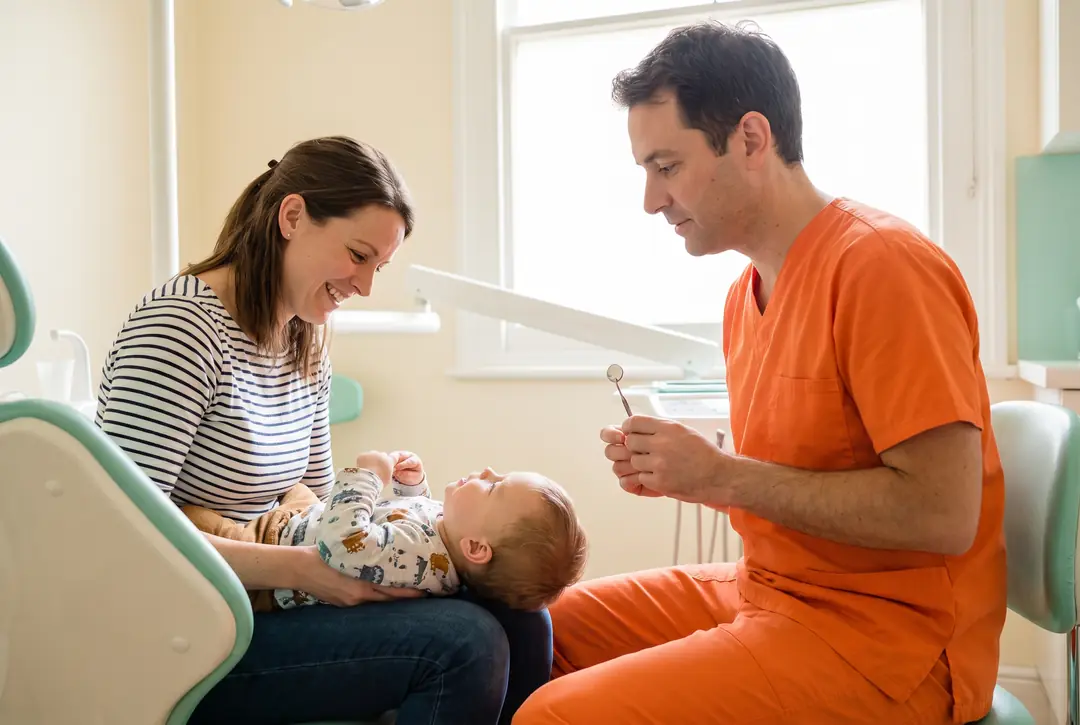
For under-threes
The knee-to-knee exam, explained properly
Two adults sit facing each other with their knees touching, so the two laps make one flat surface. Your child sits on your lap facing you, arms around you, and then lies back so that their head rests in the dentist’s lap. Their legs stay tucked around your waist and you keep hold of their hands.
From your child’s point of view they never stop looking at your face. From ours, we get a still, well-lit view into a small mouth for the ninety seconds we need it. Nobody is holding a toddler down; you are holding a toddler, which is a completely different thing, and you can sit them back up at any moment.
It works for roughly the first three years, and we will happily use it for an older child who has decided the big chair is not for them today.
What we actually look at
It looks like counting teeth with a mirror. Underneath, it is a seven-part examination, and this is the whole of it.
Soft tissues
Lips, tongue, cheeks, palate, the floor of the mouth and the frenal attachments — the tight little band under the lip or tongue that occasionally needs watching.
Eruption sequence
Which teeth are through, which are due, and whether they are arriving in the order and on the rough timetable we would expect.
The bite
How the top and bottom teeth meet. Crossbites, open bites and crowding are easier to manage the earlier somebody notices them.
Plaque and gum health
Where plaque is actually sitting on your child, not in general — usually the gum margin of the lower back teeth and the upper front ones.
Cavity risk
A written risk rating built from what we see, what your child eats and drinks, how brushing is going, and whether there has been decay before.
Feeding and habits
Bottles, sippy cups, night nursing, grazing, thumb and dummy use. We ask about all of it, and we ask without any judgement in it.
Fluoride exposure
What is in your tap water at home, what toothpaste you use and how much of it. Both matter, and most families have never been asked.
Six months is the default, not the rule
Most children come back every six months. That interval exists because it is roughly how long it takes for early decay to become something we would rather have caught, and because a six-month habit is one a family can actually keep.
Some children should be seen every three or four months instead. We will say so, we will say why, and we will write the reason down rather than leaving you to guess at it. Any of these moves the interval:
- Decay, a filling or an extraction in the last year
- White-spot lesions — the chalky early marks that come before a hole
- Visible plaque on the front teeth
- A bottle or sippy cup of anything but water at night
- Little or no fluoride in the drinking water at home
- Braces, plates or a space maintainer to brush around
- A medical or sensory condition that makes daily brushing hard
It works the other way too. A ten-year-old with no history of decay, fluoridated water and good brushing does not need to be here more often than twice a year, and we are not going to pretend otherwise.
X-rays, and when we do not take them
Radiographs are taken when there is a specific question we cannot answer by looking, and not on a schedule. The commonest question is whether decay is hiding between two back teeth whose surfaces have closed up against each other — a place no mirror and no light can reach.
- As low as reasonably achievable. Digital sensors, the smallest field that answers the question, and no repeat of an image we already have.
- A lead apron and a thyroid collar every time, without you having to ask for them.
- We tell you what we are looking for before we take it, and we show you the image afterwards whether or not it found anything.
- You can decline. If you do, we will tell you plainly what we are then unable to rule out, and we will write that down too.
What you go home with
A check-up where somebody says “all fine” and waves you out of the door has told you nothing you can act on. You leave here with paper.
- A written note of everything we saw, in plain words, including the things that are fine
- Your child’s cavity-risk rating and the two or three things that would move it
- A brushing plan with the toothpaste amount for their age — a smear the size of a grain of rice under three, a pea from three onwards, and spit rather than rinse
- The next recall date, booked before you leave the building
- A copy for your paediatrician if you would like one
Before you come
- Insurance & MedicaidWe are in-network with Ohio Medicaid managed care plans and CHIP. Kelly checks eligibility on the phone, before you drive here.
- If a standard appointment will not workDesensitising visits, the quiet room, headphones and first-slot-of-the-day bookings. Tell us before, not on the day.
- Cleanings, fluoride & sealantsWhat happens at the preventive end of the same appointment — the polish, the varnish and the grooves we seal at six.
- For kidsThe two-minute brushing timer and the chart. Worth ten minutes with your child before their first appointment.
Questions about first visits
My child is one and has four teeth. Is there anything to examine?
Yes, and the four teeth are the smallest part of it. We check the soft tissues, the way the jaws are growing, and whether the teeth that are through are arriving in a sensible order. Then we spend most of the appointment on the things that actually decide the next few years: the bottle at bedtime, how much toothpaste you are using, and whether your water is fluoridated. A first visit at one is a coaching appointment with an examination inside it.
Do I stay in the room?
Always, at any age, for any appointment. For babies and toddlers we need you in the room — the knee-to-knee exam does not work without you, because your lap is half of it. For older children it is your call and theirs. Some children are braver with a parent watching and some are braver without.
Will you clean my one-year-old’s teeth?
Usually we will wipe or brush them with a toothbrush while your child is lying back, and apply fluoride varnish if it is the right call for them. It takes under a minute and it doubles as a demonstration, so you can see the angle we hold the brush at and copy it at home. There is no scaling and no polishing cup at that age.
What if my child will not open their mouth?
Then we do not force it open. We look at what we can see, we talk to you, we let your child hold the mirror and the toothbrush, and we book them back sooner. A first appointment where nothing clinical happened is not a wasted appointment. It is the reason the second one works.
Do you take X-rays at a first visit?
Not routinely, and usually not at all. Radiographs are taken when there is a specific question we cannot answer by looking — most often whether decay is hiding between two back teeth whose surfaces are touching. If we recommend one we will tell you what we are looking for, and your child wears a lead apron and a thyroid collar.
More of what parents ask is on the questions page, and if a tooth has been knocked out or broken tonight, go straight to dental emergencies instead. You can also just ring us on (614) 555-0142.
Book a first visit
Tell us your child’s age and anything we should know before they arrive. We will send you what to expect, so nobody walks in cold.