Services · When there is already a cavity
Fillings, crowns & pulpotomies
Nobody plans this appointment. What we can do is tell you exactly what we are going to do, why that option and not the smaller one, and what your child will feel at each step.
- Ages
- All ages
- Appointment
- 45–75 minutes, depending on how many teeth
- Cost
- A written estimate before we start, and a pre-treatment estimate to your plan
What this covers
- Tooth-coloured fillings
- Crowns for badly broken baby teeth
- Pulpotomy (baby root treatment)
- Extraction when a tooth cannot be saved
Four things we might recommend, smallest first
Which one is right depends almost entirely on how much sound tooth is left, and on how long that tooth still has to do its job. We will show you the tooth on the screen and say which of these we are proposing and why.
Tooth-coloured filling
When A small or moderate cavity, with plenty of sound tooth left around it
Composite resin, bonded in layers and set with a blue light. It matches the tooth, needs less drilling than the silver fillings you may remember, and is what we use for most cavities in both baby and adult teeth.
Stainless steel crown
When A badly broken baby molar, or one that has had a pulpotomy
A pre-formed metal cap that covers the whole tooth. It is silver, it is obviously visible if you look at the back of the mouth, and it is the most reliable restoration there is for a baby molar. It comes off naturally with the tooth.
White zirconia crown
When The same job as above, where the tooth shows when your child smiles
A white ceramic cap. It looks far better and it is what most families choose for front teeth. It needs more tooth removed to fit, it is more brittle, and it is less forgiving of a child who cannot hold still, so it is not always the right call.
Pulpotomy, then a crown
When Decay has reached the nerve but the root is still healthy
The inflamed pulp in the crown of the tooth is removed, the remaining root pulp is medicated and sealed, and the tooth is capped. It keeps a baby tooth in place until it is due to fall out on its own.
Pulpotomy, or take the tooth out?
This is the conversation families find hardest, and it usually happens on a day nobody was expecting it. Here is how we actually decide.
Keep it: pulpotomy and crown
Right when the nerve is inflamed but the tooth is otherwise salvageable.
- The decay has reached the pulp in the crown of the tooth, but the root and the bone around it are healthy.
- There is no abscess, no swelling and no gum boil, and the tooth is not loose.
- The tooth still has more than a year or so to serve before it would fall out naturally.
- We remove the inflamed pulp from the crown of the tooth, medicate and seal what remains in the roots, and cap it with a crown so the tooth cannot split.
Take it out
Right when keeping it would mean treating a tooth that cannot be saved.
- There is an abscess, a gum boil, spreading swelling, or infection visible around the root.
- The tooth is broken so far below the gum that nothing can be built back onto it.
- The permanent tooth underneath is close to coming through anyway.
- Repeated treatment on the same tooth has already failed, and doing it again would mean another anaesthetic for the same problem.
If a baby molar does come out well before it was due, the teeth either side start drifting into the gap within months, and the adult tooth underneath loses the room it needed. That is what a space maintainer is for — a small fixed appliance that holds the gap open. How space maintainers work.
Local anaesthetic
Getting numb, honestly described
Numbing gel goes on first, on a cotton bud, and sits for a minute while your child looks at the ceiling screen. The injection that follows is given slowly — slowly is what makes the difference — and most children report it as a squeeze or a pinch rather than a sharp thing. Some do not notice it at all. Some do notice, and say so, and that is allowed.
We tell your child the truth about the strange part, which is not the injection. It is that half their face is about to feel fat, heavy and rubbery, like it belongs to somebody else, and that this will last a couple of hours after we have finished. Children who are warned about that cope with it. Children who are not warned think something has gone wrong.
The stop signal
Before anything starts, your child agrees a signal with us — usually a raised left hand. If it goes up, we stop. Not “nearly finished”, not “one more second”. We stop, take everything out of their mouth, and they tell us what is going on. A stop signal that is ignored once is worthless for the rest of that child’s life, and we are not going to be the practice that spent it.
While the numbness lasts
Watch for lip and cheek biting. A numb child can chew a serious ulcer into their own lip or cheek without feeling anything at all, and it will hurt a great deal tomorrow. No chewing, no gum, no straws to fiddle with, and a check every so often that they are not gnawing absently at the numb side.
Afterwards
- No chewing on the numb side until the feeling has come back — about two hours for a lower tooth, sometimes three.
- Soft food for the rest of the day. Cold is fine and often welcome.
- The gum around an injection site can feel bruised for a day or two. Sore, not sharp.
- A new filling or crown can feel tall for the first day. If it still feels tall on day three, ring us and we will adjust it — that is a two-minute appointment, not a bother.
- Sensitivity to cold for a week or so after a deep filling is normal. Sensitivity that wakes a child at night is not; tell us.
- Brush it that night as usual. There is nothing to protect.
Anything that worries you in the next few days, ring us. We would far rather answer a question that turns out to be nothing than find out at the next check-up.

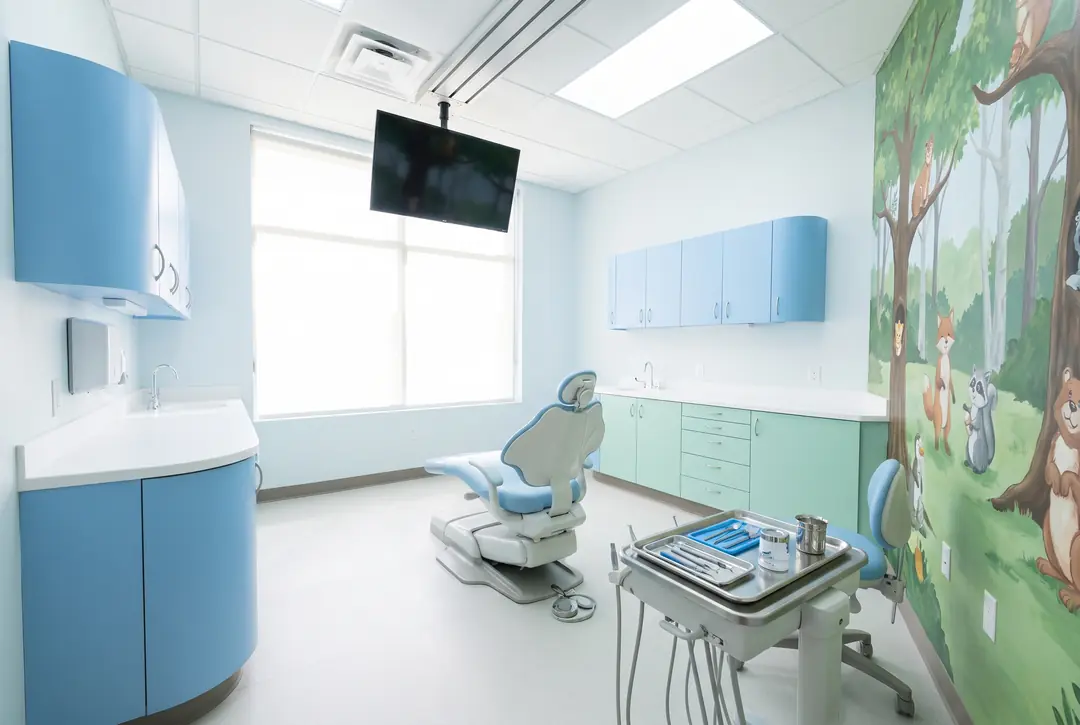
Where it happens
A ceiling screen above the chair, a nurse whose entire job during the appointment is your child rather than the instruments, and a parent chair beside them. Instruments come out of sealed heat-sterilised pouches, opened in front of you.
Questions about fillings and crowns
Why crown a baby tooth instead of just filling it?
Because a very large filling in a small tooth fails, and it usually fails at the worst possible moment. Once decay has taken out more than about half the chewing surface, or has undermined two walls of the tooth, there is not enough sound tooth left to hold a filling in place under a child who chews on it three times a day. Re-doing a failed filling means a second appointment, a second injection and a second frightened child, so where a crown is clearly the more durable answer we will say so rather than doing the smaller thing and hoping.
Will it hurt?
We will not promise you it will not. What we promise instead is this: your child will be told honestly what each step feels like before it happens, numbing gel goes on before any injection, they get a stop signal — a raised hand — that they can use at any moment, and we stop when they use it. Every time. A stop signal that gets ignored once is worthless for the rest of that child's life, so we do not ignore it.
What does a numb lip actually feel like afterwards?
Fat, heavy and rubbery, as though the lip belongs to somebody else. It is not painful, but it is strange, and small children often find the strangeness more upsetting than anything that happened in the chair. Warn them in the car on the way home. The big thing to watch for is lip and cheek biting: a numb child can chew a serious ulcer into their own lip without feeling a thing, so keep an eye on them for the two or three hours until the feeling returns.
Can the whole thing be done in one appointment?
Often, yes, if the work is on one side of the mouth. We would rather do one side thoroughly than numb both sides at once and send home a child who cannot eat or drink. Where there is a lot to do we plan it over two or three appointments, worst tooth first, and we tell you the whole plan and the whole estimate at the start rather than a tooth at a time.
A tooth has broken today. Is that an emergency?
It depends on the tooth and the break. A chipped enamel corner with no pain can usually wait for a normal appointment. A break with bleeding, a visible pink or red spot in the middle of the tooth, a tooth pushed out of position, or real pain needs to be seen today. If it is an adult front tooth that has been knocked completely out, that is a minutes-matter emergency — go to our dental emergencies page now rather than reading the rest of this one.
Talk it through first
If another practice has recommended work and you would like a second opinion, bring the X-rays or ask us to request them. We will tell you what we would do and what we would leave alone.